FIVK: Calculating and Interpreting the Inflammatory Component of the Skin State
What task the phenotypic index of skin inflammation performs and how its value should be understood
The phenotypic index of skin inflammation (FIVK — the Latin transliteration of the Russian abbreviation ФИВК) is a calculated indicator determined by a formula based on the relative numbers of skin cells of 11 phenotypes and on cell viability. In the author’s model, FIVK is a quantitative indicator of the dynamics of the inflammatory component of the skin state. This article explains what the index is made of and how to calculate it.
Quotations from the patent and the author’s statements are given in translation from Russian; the originals are in the Russian version of the article.
Why is an index needed?
A skin cytoimmunogram provides a set of indicators — the numbers of cells of many phenotypes. The patent for the method for determining FIVK (RU 2 870 371 C1) states that this prototype has no quantitative assessment of skin inflammation; the objectives of the invention are named as “quantitative assessment of skin inflammation and reduction of consumables for the study.”
The index combines the selected indicators into a single number. According to the description of the invention, the formula “reflects the ratio of the activity of inflammatory and anti-inflammatory subpopulations of skin cells, taking into account overall cell viability.”
What is the place of FIVK in the theory?
In the author’s concept, the skin state is described by many characteristics of cell subpopulations, their interactions and tissue organization. FIVK covers one side of this description: in the author’s model, it is “a quantitative indicator of the dynamics of the inflammatory component of the skin state.” The index characterizes this component, not the skin state as a whole.
Why some phenotypes are in the numerator and others in the denominator. The numerator of the formula contains seven phenotypes, the denominator four (T_c, NK, E_CD34, F_act). According to the description of the invention, the formula reflects the ratio of “inflammatory and anti-inflammatory subpopulations.” In the author’s words, this division is the first interpretation, which was taken as the basis (the author’s clarification, 20 November 2026).
What are the input data?
According to the claims, the relative numbers of skin cells of 11 phenotypes are determined. The symbol used in the formula is given in the first column:
| Symbol | Subpopulation | Phenotype |
|---|---|---|
| K_act | activated keratinocytes | CD49f+ |
| L_act | activated epidermal Langerhans cells | CD207+ |
| E_act | activated endothelial cells | CD146+ |
| M_act | activated monocytes (macrophages) | CD45+ |
| T_h | T helper cells | CD3+ |
| B | B lymphocytes | CD19+ |
| Mast_act | activated mast cells | CD249+ |
| T_c | cytotoxic T cells | CD3+ |
| NK | NK cells | CD3− |
| E_CD34 | endothelial cells | CD146+ |
| F_act | activated fibroblasts | CD45− |
| V_iab | viability of skin cells | — |
In the table of examples in the patent, the number of cells is given as “Relative number of cells, %”, and viability in per cent. According to the description of the invention, the 11 phenotypes “are the most contrasting and reflect epidermal inflammation, the dendritic-macrophage response, T-cell dominance, angiogenesis / endothelial activation, the mast cell component and dermal remodelling.”
The conditions for obtaining the data are the same as for the skin cytoimmunogram, with the patent’s refinements: a biopsy specimen taken to a depth of 1.5…3.0 mm without capturing subcutaneous fat; viability is determined with the 7-AAD dye; “To determine the phenotypic index of skin inflammation, the viability of skin cells is preferably not lower than 90%.”
How the input values relate to the skin cytoimmunogram. The FIVK method names the input data “the relative number of skin cells of a certain phenotype”; the table of examples in the patent uses “Relative number of cells, %”. On the skin cytoimmunogram report form, the percentages are calculated as follows (the author’s explanation, 21 November 2026): the percentage of a main population is calculated from all cells of the sample, and the percentage in an “of which activated” row from the corresponding parent population. Seven of the 11 indicators of the formula — K_act, L_act, E_act, M_act, Mast_act, F_act and E_CD34 — correspond to the “of which activated” rows of the form; T_h, T_c, B and NK correspond to the lymphocyte rows. The patent contains no separate rule for converting the values of the form into the input data of the formula.
What is the formula?
The formula according to patent RU 2 870 371 C1 (claims):
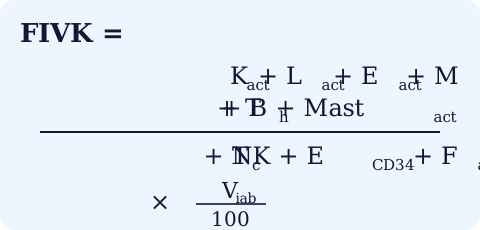
The same formula on one line: FIVK = (K_act + L_act + E_act + M_act + T_h + B + Mast_act) / (T_c + NK + E_CD34 + F_act) · V_iab / 100.
How to read the notation:
- Numerator — the sum of the relative numbers of seven phenotypes: K_act, L_act, E_act, M_act, T_h, B, Mast_act.
- Denominator — the sum of four phenotypes: T_c, NK, E_CD34, F_act.
- The numerator is divided by the denominator.
- The result is multiplied by the proportion of viable cells: V_iab / 100 (at V_iab = 95 %, the multiplier is 0.95).
This is the current formula of the method (confirmed by the author on 20 November 2026).
How is it calculated step by step?
The calculation is shown using Example 1 from the table in the patent: a skin sample from a patient with atopic dermatitis, examined before therapy.
Step 1. Input data (relative number of cells, %; viability, %).
Numerator phenotypes:
| Symbol | % |
|---|---|
| K_act | 58.4 |
| L_act | 39.7 |
| E_act | 28.5 |
| M_act | 11 |
| T_h | 12.9 |
| B | 14 |
| Mast_act | 3.1 |
Denominator phenotypes and viability:
| Symbol | % |
|---|---|
| T_c | 17.8 |
| NK | 6.3 |
| E_CD34 | 6.1 |
| F_act | 8.2 |
| V_iab | 93 |
Tables. Example 1 of patent RU 2 870 371 C1, before therapy.
Step 2. Numerator: 58.4 + 39.7 + 28.5 + 11 + 12.9 + 14 + 3.1 = 167.6.
Step 3. Denominator: 17.8 + 6.3 + 6.1 + 8.2 = 38.4.
Step 4. Ratio: 167.6 / 38.4 ≈ 4.3646.
Step 5. Viability correction: 4.3646 × 93 / 100 ≈ 4.0591.
Result: FIVK ≈ 4.06 — the same value as in the table in the patent.
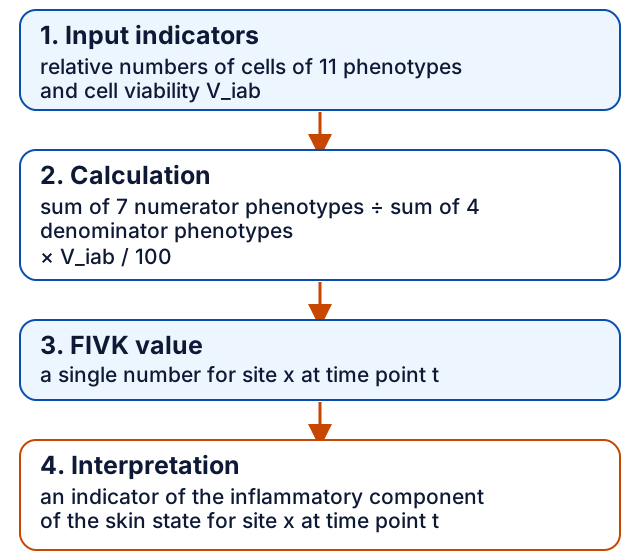
Diagram. From the input indicators to the FIVK value and its interpretation.
How should the result be interpreted?
In the author’s model, FIVK is “a quantitative indicator of the dynamics of the inflammatory component of the skin state.” The value of the index characterizes this component for a specific skin site x at time point t, not the skin state as a whole.
The published sources contain no thresholds or ranges of FIVK values.
How is FIVK used over time?
According to the claims, the index is determined for the same patient at two time points — “before and after therapy” — and their difference is compared. In terms of the theory, this is a comparison of the states of the same site at different time points: S(x, t₀) → S(x, t₁).
How to distinguish a change in the index caused by a change in the skin state from the scatter of the measurements themselves has not been established in the sources. This is formulated as an open question: “To what extent does FIVK, calculated from 11 cell phenotypes, reflect the dynamics of the inflammatory component in repeated measurements of the same skin site?”
What are the limitations, and what needs further verification?
- The published sources contain no data on the reproducibility of FIVK (repeated measurements of the same sample, of adjacent sites, in different laboratories).
- The index reflects one component of the skin state — the inflammatory one — and relies on a limited set of phenotypes.
- The result depends on the quality of the sample: the method provides for cell viability preferably not lower than 90 %.
- Open questions are on the page Open Research Questions.
Why the first model has no weighting coefficients. According to the author’s recollection (a note of 1 November 2026), when the original patent model of the phenotypic index of skin inflammation was being prepared, a decision was made not to include individual weighting coefficients for the cell phenotypes or the stabilizing parameter ε. The decision was deliberate: the aim was to fix the basic mathematical construction of the index without complicating the initial treatment with additional parameters that would require their own justification. Weighting coefficients and the parameter ε were regarded as possible directions for the further development of the model. The first patent was conceived as a fundamental stage in the development of FIVK, not as the final mathematical implementation of all the capabilities of the index.
This is the author’s retrospective account. Open questions remain: whether introducing individual weights improves the characteristics of FIVK, which method of determining the weights will be justified, how the parameter ε affects the stability and interpretation of the index, and whether the results of the basic and refined models remain comparable.
Continue reading
- Skin State: From Cellular Phenotype to a Mathematical Model — what the skin state S(x, t) is, how it can be written down and how it differs from a diagnosis.
- The Skin Cell Subpopulation Phenotype — the Unit of Investigation — what exactly is distinguished at the cellular level: the cell, the subpopulation, the phenotype and two levels of description.
- The Skin Cytoimmunogram: From Cell Suspension to a Characteristic of the Skin State — how a skin cytoimmunogram is obtained, how the report form is structured and how to read its numbers.
See also: the term “Phenotypic index of skin inflammation (FIVK)” · overview of methods · open questions
Sources
Published sources
- Goltsov S. V. Sposob opredeleniya fenotipicheskogo indeksa vospaleniya kozhi [Method for determining the phenotypic index of skin inflammation; our translation]. Patent RU 2 870 371 C1, IPC G01N 33/53. Application 2026101577 of 22.01.2026; published 21.09.2026, Bull. No. 27 (in Russian). — description of the invention; claims and table (Example 1) — full description, pp. 9–10 · Patents · Original
- Goltsov S. V., Kostolomova E. G., Sukhovey Yu. G., Pauls V. Yu. Sposob opredeleniya subpopulyatsionnogo sostava kletok kozhi i polucheniya tsitoimmunogrammy kozhi [A method for determining the subpopulation composition of skin cells and obtaining a skin cytoimmunogram]. Patent RU 2 630 607 C1. Application 2016121997 of 02.06.2016; registered and published 11.09.2017 (in Russian). — prototype — the method for obtaining a skin cytoimmunogram · Patents · Original
The author’s clarifications and materials
- Goltsov S. V. Explanations of the notation S(x, t): a formal model of the skin state, notation of a transition, the role of the skin cytoimmunogram and FIVK, definition of diagnosis (author’s statement, PDF, 2026-11-18; in Russian). — the author’s explanations of 18 November 2026, p. 2: FIVK as an indicator of the dynamics of the inflammatory component
- Goltsov S. V. Agreed clarifications for the articles on the skin cell subpopulation phenotype, the skin cytoimmunogram and FIVK (author’s statements, 2026-11-20 and 2026-11-21; in Russian). — the author’s explanations of 20–21 November 2026: the current formula; the basis of the numerator and denominator; rules for calculating skin cytoimmunogram percentages; the box on the history of the model (based on the author’s note of 1 November 2026)
This material is for information only and does not replace a consultation with a doctor.